
Calculate before you draw.
Enter the amount in the vial, the bacteriostatic water added, and the quantity you need to convert. The guide calculates concentration, volume, and U-100 syringe units.
Reconstitution, step by step
A detailed general workflow for reading the vial, drawing BAC water, transferring the diluent, and checking the result.
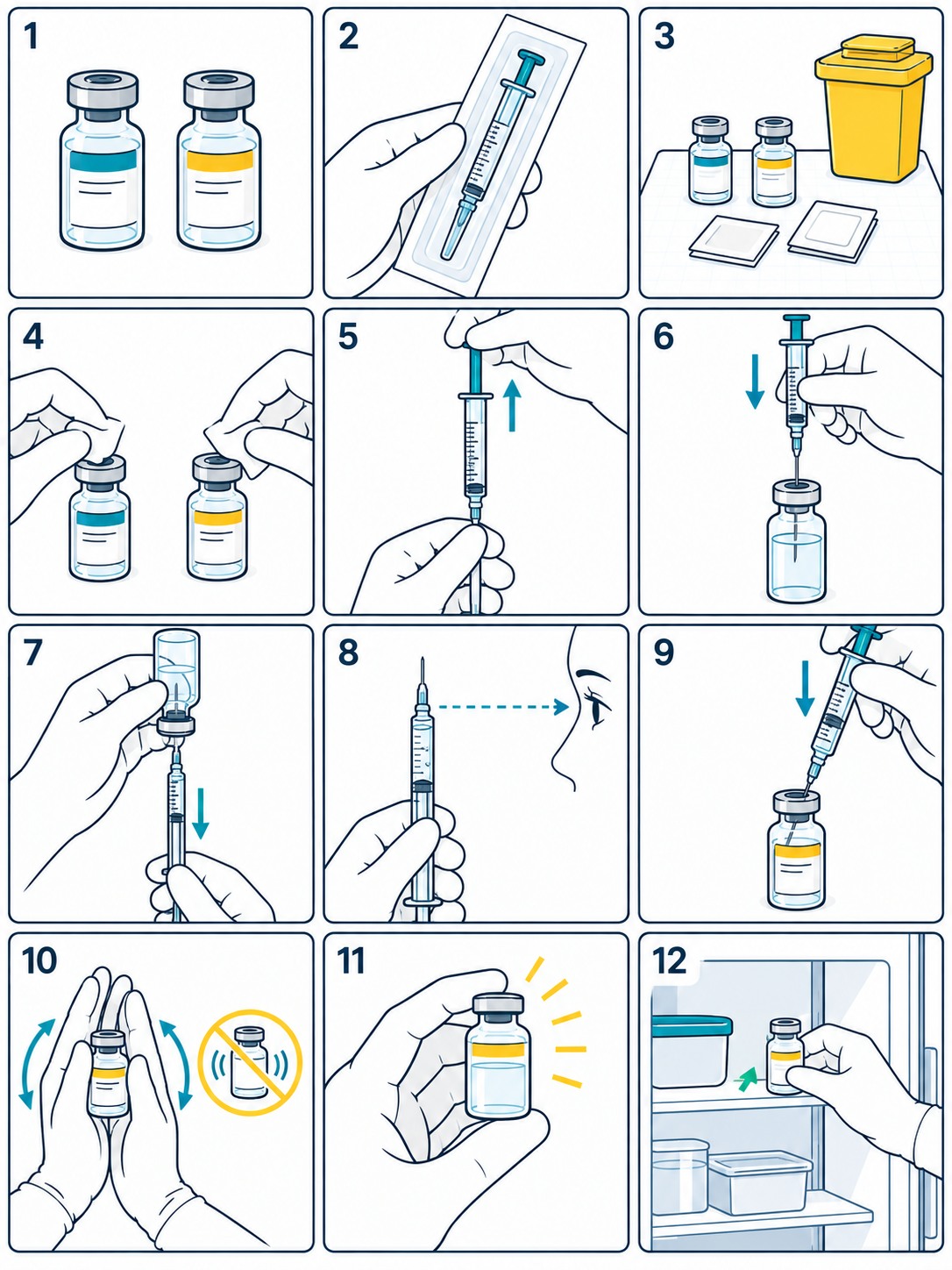
Stop and read both labels
Confirm the peptide name, total amount in the vial, expiration date, and the exact diluent and volume required by the product or protocol. Do not begin if the label, seal, or instructions are unclear.
Choose a sterile transfer syringe
Use a new, sterile, single-use syringe that can hold the full diluent volume. A 1 mL syringe is easiest to read for volumes up to 1 mL; a 3 mL syringe is generally easier for volumes above 1 mL and up to 3 mL. Use the needle type specified by the product, pharmacist, or clinician. The transfer syringe is for measuring and moving diluent, not automatically the syringe used for administration.
Prepare a clean work area
Wash and dry your hands. Place both vials, the unopened syringe and needle, alcohol pads, the written volume, and an approved sharps container on a clean, dry surface. Keep food, drinks, pets, and loose items away.
Clean both vial stoppers
Remove the protective caps without touching the rubber stoppers. Wipe each stopper with a separate alcohol pad and allow it to air-dry completely. Do not blow on it, fan it, or touch it after cleaning.
Draw air into the syringe
Open the sterile syringe without touching the needle or connection points. Pull the plunger back to the mark matching the amount of BAC water you plan to withdraw. For example, if you need 2 mL, draw 2 mL of air.
Put the air into the BAC-water vial
Set the BAC-water vial upright. Push the needle through the center of the dry rubber stopper. Keep the needle tip above the liquid and slowly press the plunger to add the air. This helps balance pressure and makes withdrawal easier.
Turn the vial over and draw the water
With the needle still inserted, turn the vial and syringe upside down. Keep the needle tip below the liquid level. Slowly pull the plunger past the desired mark, then tap the barrel so bubbles rise. Push the bubbles and extra liquid back into the vial until the leading edge of the plunger is exactly on the required volume line.
Check the measured volume
Hold the syringe at eye level and read the correct edge of the plunger according to the syringe instructions. Confirm the number one more time. If the needle touched an unclean surface or you are uncertain about sterility, discard it safely and restart with new sterile equipment.
Transfer the diluent slowly
Insert the needle through the cleaned peptide-vial stopper. When the product instructions permit, angle the needle so the liquid runs gently down the inside wall instead of spraying directly onto the powder. Add the diluent slowly. Do not force the plunger if you feel unusual resistance.
Gently roll the vial; do not shake
Remove the needle and place it immediately into an approved sharps container. When the product instructions permit, hold the vial between your palms and gently roll it back and forth until the powder dissolves. Do not shake the vial. Let it rest briefly if foam or bubbles appear.
Inspect the solution
Check the vial in good light. Follow the product description for normal appearance. Do not use it if you see unexpected particles, cloudiness, discoloration, a damaged vial, or a compromised stopper.
Calculate, label, and store
Calculate the new concentration, then label the vial with the preparation date, concentration, storage instructions, and discard date supplied by the product or clinician. Store it exactly as directed. Never assume that every reconstituted product uses the same temperature or beyond-use time.
Reconstitution reference charts
The complete mixing and U-100 conversion tables from the supplied guide.
Mixing to concentration
Choose the labeled vial strength and the amount of BAC water added. The intersection is the resulting concentration in mg/mL.
| Vial strength | 1 mL BAC | 2 mL BAC | 3 mL BAC | 4 mL BAC | 5 mL BAC |
|---|---|---|---|---|---|
| 5 mg | 5 | 2.5 | 1.67 | 1.25 | 1 |
| 10 mg | 10 | 5 | 3.33 | 2.5 | 2 |
| 20 mg | 20 | 10 | 6.67 | 5 | 4 |
| 30 mg | 30 | 15 | 10 | 7.5 | 6 |
| 40 mg | 40 | 20 | 13.33 | 10 | 8 |
| 50 mg | 50 | 25 | 16.67 | 12.5 | 10 |
All values are concentration in mg/mL.
Units to draw: U-100 syringe
Find the concentration in the first column, then move across to the quantity. Values are U-100 syringe units.
| Concentration | 50 mcg | 100 mcg | 250 mcg | 500 mcg | 1 mg | 2.5 mg | 5 mg |
|---|---|---|---|---|---|---|---|
| 1 mg/mL | 5 | 10 | 25 | 50 | 100 | 250 | 500 |
| 2 mg/mL | 2.5 | 5 | 12.5 | 25 | 50 | 125 | 250 |
| 2.5 mg/mL | 2 | 4 | 10 | 20 | 40 | 100 | 200 |
| 3.33 mg/mL | 1.5 | 3 | 7.5 | 15 | 30 | 75 | 150 |
| 4 mg/mL | 1.25 | 2.5 | 6.25 | 12.5 | 25 | 62.5 | 125 |
| 5 mg/mL | 1 | 2 | 5 | 10 | 20 | 50 | 100 |
| 6.67 mg/mL | 0.75 | 1.5 | 3.75 | 7.5 | 15 | 37.5 | 75 |
| 8 mg/mL | 0.63 | 1.25 | 3.13 | 6.25 | 12.5 | 31.25 | 62.5 |
| 10 mg/mL | 0.5 | 1 | 2.5 | 5 | 10 | 25 | 50 |
| 12.5 mg/mL | 0.4 | 0.8 | 2 | 4 | 8 | 20 | 40 |
| 15 mg/mL | 0.33 | 0.67 | 1.67 | 3.33 | 6.67 | 16.67 | 33.33 |
| 16.67 mg/mL | 0.3 | 0.6 | 1.5 | 3 | 6 | 15 | 30 |
| 20 mg/mL | 0.25 | 0.5 | 1.25 | 2.5 | 5 | 12.5 | 25 |
| 25 mg/mL | 0.2 | 0.4 | 1 | 2 | 4 | 10 | 20 |
| 30 mg/mL | 0.17 | 0.33 | 0.83 | 1.67 | 3.33 | 8.33 | 16.67 |
| 40 mg/mL | 0.13 | 0.25 | 0.63 | 1.25 | 2.5 | 6.25 | 12.5 |
| 50 mg/mL | 0.1 | 0.2 | 0.5 | 1 | 2 | 5 | 10 |
General reconstitution calculator
Mathematical conversion for U-100 syringes. Use the exact values from your vial and instructions.
U-100 means 100 units per mL. The calculator converts the numbers entered; it does not determine an appropriate dose.
Peptide-specific guides
Separate pages with tailored presets, handling notes, and dosing context.